Shared Roads

Updated: Mar 27
The overlook above Rutherford never looked like much from the highway. Just a sliver of asphalt shouldered into the hillside, a guardrail with a few dents, an oak leaning like it had secrets to keep. But at dusk it turned into a stage. The valley fell away in velvet folds, the rows of vines drawing perfect green staves across the land, and whatever rose from the wineries. Oak and sugar, a ghost of fermentation, moved through the air like a hymn.
She came for the hymn.
The Roma's V8 cooled beneath her like an exhale, its scent of warm metal blending with the oak and sugar in the air.
Tires popped gravel as she eased in and killed the engine. For a beat she sat still, palms resting on the wheel, listening to the click-click of cooling metal and the low wind combing through the oak. When she stepped out, her heels caught on the uneven shoulder. She slipped them off by instinct and set them neatly under the seat. A ritual now, like a key turned twice, she stood barefoot in the last warmth of the day.
His car was already there.
The black AMG GT waited in silhouette, paint swallowing the last amber light. Same hush of presence rather than performance.
He wasn’t leaning on the fender this time; he stood at the guardrail, hands tucked into his jacket, looking at the valley not like a tourist would, but like a mechanic after a tune, checking if the idle sounded right.
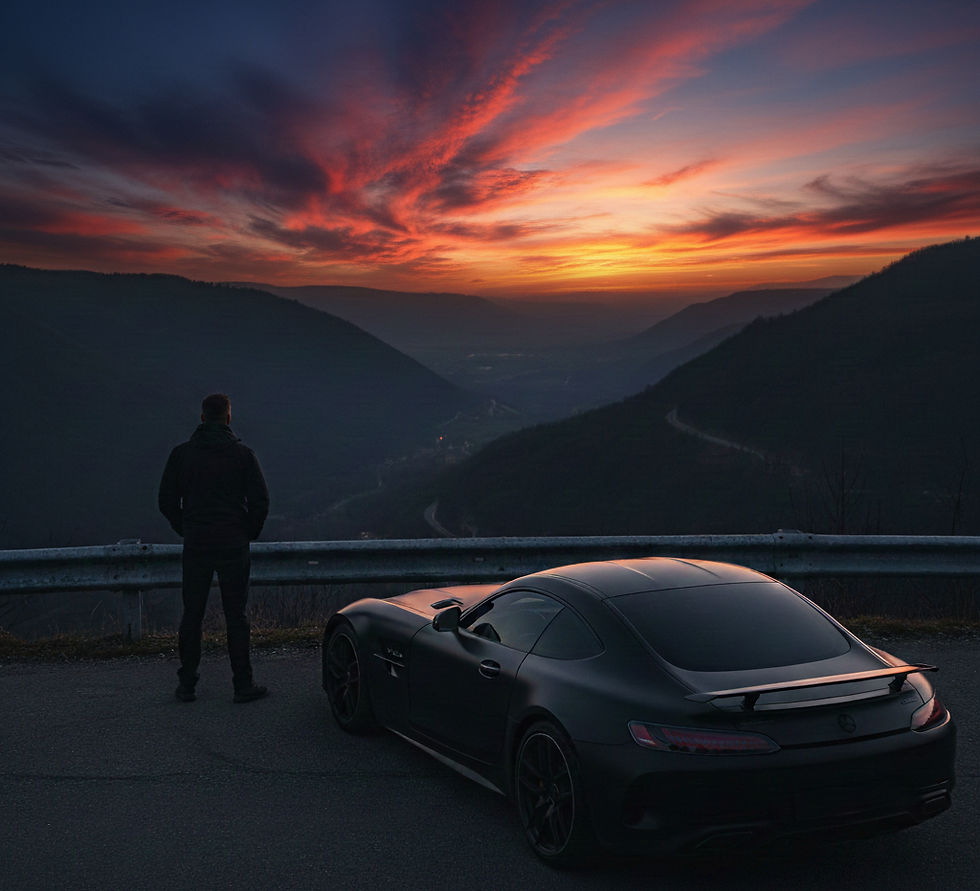
He didn’t turn when she approached; he must have seen her in the glass. Only when she took her place beside him, an arm’s length, two, did he tip his head in that almost-nod.
“Good light,” he said, voice low, the words landing without ripples.
“Best of the week,” she answered, and it was true. The sky was one long bruise of color: copper at the edges, plum pooling toward night.
They didn’t rush the silence. Engines had taught both of them that. How a patient idle says more than a stomped pedal.
Below, a box truck groaned along Highway 29, the sound rivetted throughout the valley then it was gone. Somewhere, a hawk drew slow circles. Her breath fell into rhythm with the wind.
“Silverado will be empty by now,” he said after a while, eyes still on the valley.
“Southbound?” she asked.
He smiled, barely. “There and back.”
She didn’t ask for a name. He didn’t ask where she came from or where she was going when this ended. Some meetings couldn’t hold that kind of weight; labels bent them out of true. Instead she nodded, the way drivers do at four a.m. under a freeway overpass when only taillights and trust keep you moving.
They moved.
His door shut with that compact, satisfying thud; hers answered in kind. Two ignitions flared, two engines settled: hers a familiar tenor, his a darker register that filled the space between notes. The Roma's song ran smooth and balanced; the AMG answered rougher, baritone, the harmony imperfect but true. He pulled out first, easy, unshowy, and she tucked in two car-lengths behind, far enough to breathe, close enough to belong.
The road along the ridge ran like a sketched line, then dropped them toward the valley. Headlights brushed the oaks, found the reflective teeth of the centerline, feathered across the backs of roadside signs. At the stop, he rolled left onto Silverado Trail. The asphalt unspooled, long and clean and almost empty.
This, she knew. The way the valley changed moods after dark; tasting rooms shuttered, buses gone, the whole place exhaling into a softer version of itself. The vineyards held their chill; fog teased the edges like a curtain thinking about falling.
He kept the pace honest. Neither of them was here to prove anything. The dance was elsewhere: in how he clipped the apex and left the exit wide, in how she mirrored his brake lights without getting greedy, in the way their beams overlapped and separated and overlapped again, like breath. The Roma held her line like silk drawn taut; the AMG carved broader arcs, muscle over melody.
Songs on the radio turned to texture. The cabins smelled of warm leather and a trace of fuel. When he signaled, a small courtesy most forgot at night, something inside her eased. She found the groove the way you find a lover’s pulse: not by searching, but by relaxing into where it obviously is.
Mile markers winked by. Oakville. Yountville. Oak Knoll. The whole valley a strip of fireflies caught in their glass.
At a long straight, he drifted to the right a hair; she slid up to run door-to-door for a heartbeat, two. The world narrowed to side windows and motion, two machines sharing speed like a secret. He turned his head, just a fraction, and in that brief parallel, their profiles lined up in the reflection of each other’s glass. Then he let her go ahead.
She led for a while through a shallow S, past the dark spine of a winery, across a patch of road that always sang under the tires; and felt the odd, steadying weight of being trusted. He stayed there, a constant in her mirror, the kind of presence you don’t have to check for because you know you’ll find it when you do.
They turned east at Trancas, then climbed into the Monticello hills where the asphalt tightened. The smell shifted to eucalyptus, damp rock, hot brakes cooling at switches. The night thickened. Her focus narrowed to the next crest, the next small straight, the next gentle brush of pedal. He gave space on the climbs, closed it on the descents, the etiquette of people who have learned by feel and loss.
At a turnout halfway up, he blinked his highs twice and eased off. She followed, tires popping gravel again, engines cutting in near-unison.
Night laid itself over them fully now. The valley lights had pulled their quilt up to the chin. From this height, the wineries were only constellations.
“You know these roads,” he said, not as a question.
She shrugged, smiling into the dark. “Know what they do to me.”
“That too.”
They stood there until the heat bled from the hoods. Crickets started up somewhere in the manzanita. A late plane stitched a slow line across the sky toward the coast.
He stepped to the guardrail and tapped it twice with two knuckles. A habit, a tic, a blessing. She wondered who taught him; she wondered who she’d been before she learned to wonder.
“Back the same way?” he asked.
“Back the same way,” she said, and neither of them said together, because saying it would have made it smaller.
Before they climbed in, she bent to retrieve her heels from where she’d tucked them under the seat and hesitated. They didn’t belong with her right now, not even as cargo. She set them in the passenger footwell, then reached across and pushed them gently under until they disappeared. When she straightened, he was watching. He was curious, amused, like he understood and had no need to name it.
He led the descent. She took the slot behind, trusting his line where the corners went blind. The valley rose to meet them in slow increments of light and scent and sound. Somewhere near the bottom a fox flashed across the road, and both of them, without thinking, without braking hard, feathered just enough to let it pass between their beams as if the night itself had asked permission.
At the Trail, they paused at the same stop in a bubble of stillness neither was ready to puncture. South would take him home, or north, or maybe nowhere. They hadn’t written maps into this. She rolled forward first, and he didn’t follow, and for a second disappointment pinched behind her ribs.
Then his high beams flicked: one, two, and she caught the motion in the mirror: a small wave through the windshield, palm up, the universal sign for go on, I’m here.
She drove. Not away. Not toward. Just with. Headlights braided and unbraided behind her, the road unwound its ribbon, the night made room for two.
At the Rutherford overlook again, he pulled in; she did too. Engines off, doors shut, the world loud with crickets and far-off tires she could no longer see.
They didn’t linger long. He touched the guardrail once more on the way back to his car. She watched the motion and felt it land on her like a vow: light, private, real.
“Next week,” he said, and the words were simple enough to hold without fear.
“Same light,” she answered.
Engines turned; the AMG's growl found its answer in the Roma's steady hum.
When she slid onto the road barefoot, heels hidden beneath the seat, the twin rhythms folded together until the night sounded completed.


Comments